Our two month blog anniversary is right around the corner (Friday the 9th if you want to send a gift) so I thought I'd take a moment to talk about the blog itself. If you are reading this you must know what a blog is and how it works...or do you. I thought I did until I started getting involved in the nuts and bolts of this blog.
See, blogs are easy to set up. The trick is in getting readers and in keeping them. As much as we enjoy talking about our research, it takes a bit of time and coordination to make sure we get a post up everyday. (Despite what Jim thinks, we didn't miss a post last week.) What makes this effort worth while is knowing that people are reading. (You are still reading, aren't you?).
If you haven't noticed already, the left hand side of the blog has some features that I added to help us keep track of site traffic and to help us improve the blog. The stats are fun to look at. I was thrilled when someone in Moscow spent 3.5 hours reading here but that doesn't tell me much about why that visitor came here or stayed so long. That is the purpose of the poll, also in the left hand column. Every 6 weeks or so I put up some of my new ideas for the blog and let the visitors vote so I know what you want to see...or don't want to see. Of course you can always leave a message after one of the posts or send one of us a message. Our e-mails are listed on our profile pages, also on the left hand column.
To get the word out about this blog I have added us to a slew of blog directories. These sites list us for free if we provide a link back to them, hence the long list of buttons near the bottom of the left column. Some of these sites allow visitors to vote for their favorite blogs or even rank the blogs. The more votes or the higher rank we get, the easier it is for people to find us.
Another way to spread the word about our blog is to become part of a blog carnival (who knew?). A blog carnival is like a magazine of blogs about a specific topic. There is only one archaeology blog carnival that I know of, it is called Four Stone Hearth, and we are featured in the latest issue. You can catch up on back issues of Four Stone Hearth here or read the most recent at the Sorting Out Science blog which is here.
For those of you who are dedicated readers, you might be interested in our feed. Since we do not post a blog at the same time every day, it may be easier to keep track of us through our Atom Feed, also in the left column. By subscribing to the feed you will be notified every time a new post is made. Most browsers (like Safari or Firefox) allow you to subscribe to feeds by clicking on the atom link and then bookmarking that page in the browser. Then when a new post is made here, your browser will show the number one next to our name in your bookmarks.
As always, if you have any questions or comments, feel free to contact us. We would like to see more comments being left here, after posts, just so everyone can feel like there is a community here. But, readers have been e-mailing Jim on a regular basis and that is fine too. We have to keep Jim busy.
That's all for now. Tomorrow's blog should be a lab update from the boys.
-April
Wednesday, November 7, 2007


Tuesday, November 6, 2007
Chesapeake/Potomac Hurricane of 1933
Yesterday, Jim blogged about the sediment at Port Tobacco. It is dificult to convey the importance of "layers of dirt" at this site. In essence, some parts of the town appear to have been buried by feet of silt, and others by feet of gravel, while some areas have very little of either. To complicate matters, the soils encountered in shovel test pits behind the Burch House bear little resemblance to those in front of it. Major storms are a probable source of these silt and gravel deposits. Heavy winds, rains, and floods can move a large amount of soil, especially in areas where natural vegetation has been lost to farming and livestock grazing.
The National Oceanic and Atmospheric Administration maintains an on-line databse of major storms; however their records do not begin until the late 1800s. A search of the historical hurricane tracks show that one major hurricane passed right over Port Tobacco, the Chesapeake/Potomac Hurricane of 1933. By reviewing accounts of this storm's impact on the town we hope to get a better sense of the impact of earlier storms.

There are several accounts of this hurricane available on-line, many of which compare it to Hurricane Isabel of 2003. One account compared the effects of the two storms on one property in Maryland. One difference was that the 1933 storm deposited 3.5 feet of sediment!
-April
The National Oceanic and Atmospheric Administration maintains an on-line databse of major storms; however their records do not begin until the late 1800s. A search of the historical hurricane tracks show that one major hurricane passed right over Port Tobacco, the Chesapeake/Potomac Hurricane of 1933. By reviewing accounts of this storm's impact on the town we hope to get a better sense of the impact of earlier storms.

There are several accounts of this hurricane available on-line, many of which compare it to Hurricane Isabel of 2003. One account compared the effects of the two storms on one property in Maryland. One difference was that the 1933 storm deposited 3.5 feet of sediment!
-April
Monday, November 5, 2007
Sediment, the Neglected Artifact
Archaeologists like stuff...there's no denying it. We revel in artifacts and, most particularly ceramics. And there are good reasons for that: artifacts in general, and ceramics in particular, can be dated, described in any number of ways, and illustrated. Reports and publications rich in artifact photographs and drawings will garner more attention then those with tables, charts, and unit profiles. (Compare the tin-glazed sherd and the profile drawing from one of our units at Port Tobacco.)


It isn't surprising, then, that the bulk of archaeological data receives very little attention, both in the field and in the lab. Most of it, in fact, is pushed through screens and then disposed of in piles or used to backfill excavation units. When it comes to documenting soil, a brief description of color and texture is all that typically happens. The more fastidious will seek several colors and several textures in what many would regard as a single layer of undifferentiated soil; but even that detailed information rarely finds its way through analysis and into the main body of the report. The project team is determined not to let that happen at Port Tobacco where, we think, soils hold the key to much of what happened to the town between its founding in the early 1700s until its virtual abandonment around 1900.
April and I have been planning a detailed strategy for studying the sediments at Port Tobacco, the first stage of which occurred, and will continue, during our shovel testing. Much of that work, we hope, will be underwritten by several grants; so I will not go into a great deal of detail. We hope to use sophisticated geophysical survey equipment, specifically a ground-penetrating radar and a proton magnetometer, coupled with more conventional archaeological techniques, to recover the data that we need. We will then analyze those data with the aid of advanced computer technologies such as three-dimensional computer-aided drafting and geographic information systems.
Oddly enough, for archaeologists, we intend to use the geophysical survey equipment in the manner in which it was originally intended...to explore site geology. But that isn't to say we will not seek archaeological deposits as well. The equipment, if we are successful in securing it, will help us identify buildings, graves, derelict vessels in the river, and buried wharves and piers along the banks. Exciting stuff, all of the digital, quantitative data that these gizmos can produce; but fear not: we'll still be out there looking for and collecting artifacts, and pictures of pots and shoe buckles will take their rightful places next to the charts, tables, and profiles.
Jim
Sunday, November 4, 2007
In Search of President John Hanson
This past Friday I made a return visit to Mulberry Grove, a plantation house just south of Port Tobacco. While lying outside of Port Tobacco proper, Mulberry Grove and other plantations and farms were critical to the town's survival. The farmers raised the tobacco that comprised the principal export and they brought their patronage to merchants and tradesmen in town. No study of Port Tobacco can be balanced without learning something of its rural neighbors.
The purpose of my visit, however, was not strictly archaeological. Scott and I went there to assess the condition of the Hanson-Fergusson cemetery with an eye toward helping the current owner, Mr. Ed Edelen, restore it. We also share Mr. Edelen's interest in learning the fate of the mortal remains of John Hanson, the first President of the United States of America under the Articles of Confederation (1781-1782), before the adoption of our present constitution.
Scott and I are considering ways in which we can determine whether this is a grave without actually disturbing the grave. We also are considering measures to repair and plumb the rest of the monuments that mark the graves of Mulberry Grove's occupants. (Scott is certified in the repair of marble monuments and the two of us have worked on the documentation and restoration of several cemeteries in Maryland and Delaware.) While the search for John Hanson has its own particular interests and challenges, the search for cemeteries in the area will not end there. We know there is at least one cemetery at Port Tobacco buried beneath the silt, and I suspect there are others, and there are likely others at neighboring plantations. We are hoping to receive a grant that will allow us to purchase some of the advanced technologies that will improve our ability to locate and define cemeteries without necessarily excavating them. Keep fingers crossed.
Jim
The purpose of my visit, however, was not strictly archaeological. Scott and I went there to assess the condition of the Hanson-Fergusson cemetery with an eye toward helping the current owner, Mr. Ed Edelen, restore it. We also share Mr. Edelen's interest in learning the fate of the mortal remains of John Hanson, the first President of the United States of America under the Articles of Confederation (1781-1782), before the adoption of our present constitution.
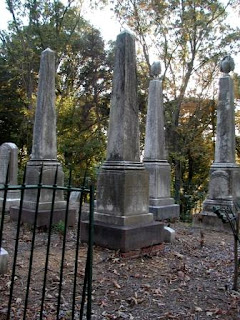 Fergusson monuments at Mulberry Grove.
John Hanson was born at Mulberry Grove in either 1715 or 1721 (we are not sure). Although he resided in Frederick County at the time of his death, he met his end at his nephew's home at Oxon Hill, Prince George's County, in 1783. He is reputed to have been buried at Oxon Hill, but there is no monument marking his grave there, in Frederick, or at Mulberry Grove. His wife Jane (nee Contee), however, was buried at Mulberry Grove upon her death in 1812, as are two of their infant children. Each of those three graves is marked by a ledger stone (a large, flat piece of marble placed horizontally on a brick foundation), and there is a space between Jane's monument and those of her two children. Furthermore, there is a depression in that space. Had someone dug a hole looking for a grave? or is the depression a grave, possibly that of John Hanson?
Scott and I are considering ways in which we can determine whether this is a grave without actually disturbing the grave. We also are considering measures to repair and plumb the rest of the monuments that mark the graves of Mulberry Grove's occupants. (Scott is certified in the repair of marble monuments and the two of us have worked on the documentation and restoration of several cemeteries in Maryland and Delaware.) While the search for John Hanson has its own particular interests and challenges, the search for cemeteries in the area will not end there. We know there is at least one cemetery at Port Tobacco buried beneath the silt, and I suspect there are others, and there are likely others at neighboring plantations. We are hoping to receive a grant that will allow us to purchase some of the advanced technologies that will improve our ability to locate and define cemeteries without necessarily excavating them. Keep fingers crossed.
Jim
Saturday, November 3, 2007
Grants and Lab Happenings
Yes, we were slackers yesterday. None of us posted a blog, so let me catch you up on what has been happening.
Through two of our sponsoring organizations, we have received two grants:
Southern Maryland Heritage Area Consortium: $1,000
Preservation Maryland: $3,000
We greatly appreciate their help.
These two grants help us maintain momentum until we can arrange more long-term funding. April and I have prepared, and are in the process of preparing, additional grant applications. Because of the difficulties that grants--"soft money"--present for long-term planning, we are trying to fine a more reliable source to underwrite efforts at Port Tobacco.
Lest you think we spend all of our time panhandling, I'd like to report that our next lab day at the Maryland Historical Trust (Wednesday,November 7, 9AM to 3PM) should complete the task of washing all of the artifacts from our late October volunteer weekend. Many thanks to Stephen, John, and Walt for their help. Of course, we still need to catalogue and re-bag all of that material...and there is a lot...so we will continue lab days on Wednesdays, and perhaps some Thursdays and Fridays, through November. Let us know if you can help.
Special note for candidates in the Archeological Society of Maryland's Certified Archeological Technician program: I am amenable to organizing workshops over the next few months. Let me know where and when.
Jim
Through two of our sponsoring organizations, we have received two grants:
Southern Maryland Heritage Area Consortium: $1,000
Preservation Maryland: $3,000
We greatly appreciate their help.
These two grants help us maintain momentum until we can arrange more long-term funding. April and I have prepared, and are in the process of preparing, additional grant applications. Because of the difficulties that grants--"soft money"--present for long-term planning, we are trying to fine a more reliable source to underwrite efforts at Port Tobacco.
Lest you think we spend all of our time panhandling, I'd like to report that our next lab day at the Maryland Historical Trust (Wednesday,November 7, 9AM to 3PM) should complete the task of washing all of the artifacts from our late October volunteer weekend. Many thanks to Stephen, John, and Walt for their help. Of course, we still need to catalogue and re-bag all of that material...and there is a lot...so we will continue lab days on Wednesdays, and perhaps some Thursdays and Fridays, through November. Let us know if you can help.
Special note for candidates in the Archeological Society of Maryland's Certified Archeological Technician program: I am amenable to organizing workshops over the next few months. Let me know where and when.
Jim
Friday, November 2, 2007
Lab work at the Maryland Historical Trust
What a start to the lab process this week! After all of our hard work during the volunteer weekend there was a lot of washing to be done and almost all of it is done! Now that is only the start of the artifact analysis that we must do. With the help of several volunteers over the past two days over three quarters of the artifacts have been washed.
Not only does having multiple people wash the artifacts make things go smoother and faster we also have some fun and get to see up close all of the great things pulled out of the ground. There were several pieces of Rhenish ware, creamware, and plenty of architectural debris that came up along with Native American pottery (Potomac Creek Corded to be exact) and projectile points. One thing in particular caught my eye, a pipe stem that had been imbedded into a wall as part of the plaster! It's always the little things that catch my eye.
Next week we will be back in the lab on Wednesday finishing the washing and starting to rebag and catalog the collection to date. So come on out and join us at the Maryland Historical Trust this coming Wednesday. Again our thanks go out to all of our volunteers and the Trust for allowing us to use their lab.
-Pete
Not only does having multiple people wash the artifacts make things go smoother and faster we also have some fun and get to see up close all of the great things pulled out of the ground. There were several pieces of Rhenish ware, creamware, and plenty of architectural debris that came up along with Native American pottery (Potomac Creek Corded to be exact) and projectile points. One thing in particular caught my eye, a pipe stem that had been imbedded into a wall as part of the plaster! It's always the little things that catch my eye.
Next week we will be back in the lab on Wednesday finishing the washing and starting to rebag and catalog the collection to date. So come on out and join us at the Maryland Historical Trust this coming Wednesday. Again our thanks go out to all of our volunteers and the Trust for allowing us to use their lab.
-Pete
Thursday, November 1, 2007
Port Tobacco and the Civil War, Part 2
While Port Tobacco was located in Union territory, it saw quite a bit of Confederate activity.
The Century Illustrated Monthly Magazine By Roy J. Friedman Mark Twain Collection (Library of Congress): "The road over which it was proposed to conduct the distinguished captive [Abraham Lincoln] was known in the secret service of the Confederacy as the underground route that is a route not generally known between Richmond and Washington and used by spies and contrabandists in the employ of the South. It ran a roundabout course through southern Maryland across the Potomac in the vicinity of Port Tobacco Creek or Pope's Creek and thence to Richmond crossing the Rappahannock at Port Conway and Port Royal. It was overland route in fact that could be taken to Richmond as all communication north from that city was cut off in Virginia and even it was guarded with more or less care by the Federal authorities so that travel thereby was attended with no little danger. Over this course too the Confederate mail passed daily on its way to Richmond or Montreal and such was the secrecy with which the underground mail service was maintained that a man might be engaged in it during the entire war without the knowledge of his family."
This route was used for much more than just communications, as this account of Confederate Secret Service operations shows.

Source is: Confederate Covert Action in the American Civil War By William A. Tidwell, Published 1995 Kent State University Press
The Century Illustrated Monthly Magazine By Roy J. Friedman Mark Twain Collection (Library of Congress): "The road over which it was proposed to conduct the distinguished captive [Abraham Lincoln] was known in the secret service of the Confederacy as the underground route that is a route not generally known between Richmond and Washington and used by spies and contrabandists in the employ of the South. It ran a roundabout course through southern Maryland across the Potomac in the vicinity of Port Tobacco Creek or Pope's Creek and thence to Richmond crossing the Rappahannock at Port Conway and Port Royal. It was overland route in fact that could be taken to Richmond as all communication north from that city was cut off in Virginia and even it was guarded with more or less care by the Federal authorities so that travel thereby was attended with no little danger. Over this course too the Confederate mail passed daily on its way to Richmond or Montreal and such was the secrecy with which the underground mail service was maintained that a man might be engaged in it during the entire war without the knowledge of his family."
This route was used for much more than just communications, as this account of Confederate Secret Service operations shows.

Source is: Confederate Covert Action in the American Civil War By William A. Tidwell, Published 1995 Kent State University Press
Subscribe to:
Posts (Atom)


 Posts
Posts


