Showing posts with label St. Nicholas. Show all posts

Sunday, November 1, 2009

More St. Nicholas

It is a rainy Sunday and All Saints Day, so I thought I would post a few more pictures from our final day of monument recovery at St. Nicholas Cemetery.

Near the existing early 20th-century church, the US Navy had mapped several markers in 1943. Years after the Navy toppled and buried those stones, it built a parking lot on the east side of the church and a sidewalk that wrapped around from the east to north sides. The topography on the north side of the church, however, was too steep at the time for parking lot and sidewalk construction. The Navy leveled the land by dumping two feet or more of fill. The fill further buried the monuments.

Scott and I managed to recover all but one of the mapped markers, but we thought the depth of the fill made finding...never mind recovering...the last stone impractical. Clever men that we are, we decided to add that stone to our list of monuments that might best be recovered with machinery.

Last Friday, that is what we did: we used the backhoe to remove a couple of feet of fill, allowing us to easily probe the sediments for the missing stone. It was remarkably easy, and we turned a three hour job with an uncertain chance of success into a one hour job with certain success.

In this sequence of photographs, you can see where we started, the point at which we were able to find and delineate the stone and its plinth or base, and the final lifting of the stone.

We haven't re-erected the stone yet...it is lying on the grass next to the backfilled hole. We are waiting for the soil to settle after a good rain and Scott has to replace the two under-sized metal pins that originally held the marker on its base. When re-erected, the monument will be in its correct horizontal position, but it will be about 1.5 ft higher than its original setting to adjust for the thick layer of fill the Navy deposited. If we set the marker on the original ground surface, only the top would protrude above the current grade.

Jim

PS. The PTAP team returns to the Swann House site at Port Tobacco Monday and Tuesday of this week. All are welcome. Our schedule for the remainder of the week is uncertain as we may have to schedule fieldwork for projects in adjoining counties.--JGG

Saturday, October 31, 2009

St. Nicholas Cemetery Finished!

Although there are a few monuments to repair and re-erect, and some others that have to be re-plumbed, for all intents and purposes we finished the St. Nicholas Cemetery restoration fieldwork on Friday. And no lives or limbs were lost in the process...not that there weren't some close calls.

After six years of muscling stones out of the ground, Scott and I are broken, but wiser men. Scott raised some money to pay for a machine to excavate and raise the last four monuments which we knew to be very large and heavy, or deeply buried beneath construction fill.

See the large stone exposed in the photographs above and to the left...that's just the base. Granite markers became very popular in the early 20th century as cutting and polishing technologies developed and the Vermont monument makers became more innovative in marketing the 'rock of ages.' Although virtually indestructible and requiring no repair, only resetting, the granite markers at St. Nicholas posed a problem. They were generally much larger and far heavier than the marble monuments. We managed to re-erect several over the past six years using a chain pull and sweat, but just barely averted severe injuries to the foolhardy crew. Machinery allowed us to recover and reset the monuments Friday with minimal risk. It would otherwise have taken us an additional day or two, and we might not have returned Pete in the same condition as when he arrived on site.

The actual marker for the Freeman family, which sat on the granite base from 1935 to 1943, appears in the photographs to the right and below. If lifted into the bed of my small pick up truck it would just fit. Of course, given the weight of granite, it would have crushed my pick up truck, eliminating the need for that overdue oil change and brake cleaning.

It took Scott, Pete, and I, Cory the machine operator, and Laurie (she took these pictures) six hours to complete the work.

Over the coming months, Scott and I will prepare a report and a website for researchers, and Scott also will work with a genealogist on a book about the cemetery and the families buried there. We'll announce through this blog the completion of those tasks with information on how readers can access those final products of this project.

My heartiest congratulations to Scott Lawrence who conceived the project and navigated the often resistant State and Federal bureaucratic systems to make the project a reality, and who then sought the training and developed the expertise needed to repair scores of damaged marble monuments. It was a lunatic idea for Scott to undertake this volunteer project, although in retrospect it doesn't seem so hair-brained. Success alters memory.

Jim

Thursday, October 29, 2009

In the News

A busy and somewhat hectic day at Port Tobacco. Anne and Kelley spent an hour or more with a photographer from the local newspaper showing some of the artifacts that we have recovered. The photographs will accompany interviews conducted by journalist Nancy McCanaty regarding Charles County's important artifacts and how they are cared for.

Pete has written a short blurb about the PTAP and Swann House work for the Society for Historical Archaeology Newsletter, a publication for professionals.

Today we began the tedious job of carefully documenting the exposed foundation of the Swann House, drawing each brick and stone. We should complete that work next week when we return to the site.

I spent some time with Dr. Dorothy Barbour, owner and occupant of Stagg Hall, one of three surviving 18th-century buildings in Port Tobacco and one of the best preserved in Maryland. It has been Mrs. Barbour's dream to see Stagg Hall become a museum in a larger outdoor museum celebrating the history of Port Tobacco.

Anne and Kelley will be in the office tomorrow working on technical reports and writing a blog, while Pete and I join Scott in finishing the cemetery restoration at Patuxent River Naval Air Station. I'll blog on that work this Saturday.

Jim

Sunday, September 27, 2009

St. Nicholas Wrapping Up

Rather than work on Port Tobacco material, I spent Saturday at St. Nicholas Cemetery with Scott and Laurie. Batteries in my camera died, so I do not have any pictures. We resurrected 17 markers (possibly a record, for us, for most recovered in one day), and that places us within two field days of completing the recovery phase of the restoration. (We still need to plumb a few markers and fill in some depressions.)

With luck, we will finish the effort, the largest of its kind in the area, and possibly in the State of Maryland, within days of the sixth anniversary of our first day recovering markers. Looking around us after re-erecting the last monument for the day, I was impressed with what we had accomplished and, briefly, wondered what the hell motivated us to undertake such a massive and physically demanding project. Probably one of those brief bits of insanity that we all experience from time to time.

Jim

Friday, September 25, 2009

Scott Lawrence

This week I turn the spotlight on PTAP team member Scott Lawrence.

I've been working with Scott since 2003 when he approached me with the lunatic idea of restoring a completely buried cemetery. Apart from the sheer scale of the undertaking, there was the added problem of dealing with not one, but two government bureaucracies...state and federal...because the cemetery in question sits smack in the middle of the Patuxent River Naval Air Station in St. Mary's County. Neither bureaucracy, at the outset, was keen on a grassroots, amateur effort at restoration; but nor was there any prospect of a well-funded, professional restoration effort of this cemetery which had been demolished in advance of base construction in 1943.

As it turns out, the St. Nicholas Cemetery Restoration Project became a professional undertaking as Scott sought the training necessary to properly repair the many broken monuments (more than 100). Here Scott is pictured with one of the first, if not the first monument that we re-erected at St. Nicholas...the grave marker of John Albert Edgeston, an African American infantryman who died soon after his return home in 1919.

Scott has undertaken restorations at a number of cemeteries in the region since we began the St. Nicholas project and, when he isn't digging with the PTAP team, he passionately promotes the preservation and restoration of cemeteries. We anticipate completion of the restoration in the next few months, six years after we began, re-erecting over 200 monuments.

Jim

Saturday, September 5, 2009

Duxul Lexer

Laurie, Jim, and I spent the day recovering markers at St. Nicholas again. We recovered another 10 markers and we are about 81% complete! After 7 years of this project, we are all eager for it to end.


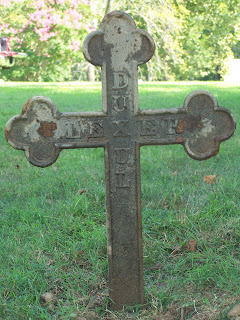
We recovered two markers today that reminded me of some other markers I had seen at St. Ignatius Cemetery in St. Inigoes. These metal crosses have names and dates on the front and a curious inscription on the back. For years this inscription baffled me.


Duxul Lexer


It just didn't make sense. I contacted Fr. Rory Conley about what it meant. Fr. Conley did not have the quick answer, but consulted with Rev. Msgr. Joseph Ranieri of the Archdiocese of Washington and he has determined the following:

First off, "duxul" and "lexer" are not Latin words. However, with "X" as the center, you have four Latin words: "dux" meaning guide; "lex" meaning law; "lux" meaning light, and rex meaning king. An "X" of course is an ancient symbol for Christ. Thus, the inscription probably means "Christ is my guide, my law, my light, my king."

Brilliant! Those Catholics sure were crafty!

Saturday, August 29, 2009

St. Nicholas

Not much to report today. Scott and I spent the day at St. Nicholas Cemetery resurrecting twelve more gravestones with the help of volunteers Laurie and Violet. We are rapidly nearing the end of this seven year effort to restore a community cemetery that was demolished in advance of the construction of the Patuxent River Naval Air Station in 1943.

when the effort is finished, Scott or I will blog about it, summarizing what we have accomplished. For the moment, however, we are both exhausted. Sixty percent humidity made it tough.

Friday, February 6, 2009

Update

A slow new day today...Jim and Scott are playing down at St. Nicholas cemetery. I am in the office labelling artifacts. It was not my original plan today but as I was photographing Aboriginal artifacts for Jim's and April's presentations (separate ones in separate states) I noticed that many of them had not been labelled. So today I am labelling some and photographing some, playing with lighting to get better shots along with some writing that needs to be finished.

That's all for today...I'm sure Jim or Scott will update us on what was done at the cemetery sometime this weekend.

- Peter

Friday, January 9, 2009

Handyman at Work

Jim and Scott are off playing at the St. Nicholas cemetery today. So I am left to hold down the fort so to speak. No new news on Port Tobacco today. I have been organizing all the deeds for the town and looking for others.

Today and next week are going to be tests to my handyman skills as all of our screens need to be repaired. Either new screens needed to be put in, handles made, or adjustments to "ricketiness" have to be done. Now, for those of you who don't know me, I am not exactly "Mr. Handy". Actually, I'm lucky if I can find the right side of the hammer to use (Dad, I know you can relate).

I'll post some pictures next week on the process...that is if I survive the ordeal.

Sunday, November 9, 2008

St. Nicholas Cemetery Restoration

As Jim mentioned yesterday, we returned to St. Nicholas Cemetery at NAS PAX River. Let me provide a brief history of the project and how this relates to Port Tobacco.

The area known as Cedar Point in St. Mary's County was occupied by the English colonists from the early 17th century. Many manors and plantations grew over the years in the vacinity until 1942 when the Navy acquired the land for an aircraft test center. For reasons unknown, one of the acts of the Command was to bury the extant cemetery at St. Nicholas and to demolish the 1795 church. In 2002, I sought permission from the Navy to ressurect the cemetery and enlisted the help of Jim to complete the task.

To date, 83 stones have been repaired and or re-erected at the site. My records show at least another 140 stones to be recovered. Most of the almost 700 known burials are unmarked. We carefully and fully document all excavation procedures and, when the project is complete, will submit a full report to the Navy and the Maryland Historical Trust.

The techniques I have learned over the years can be directly applied to cemetery restoration and stone repairs at Port Tobacco, should any stones be recovered. Our techniques are proven and documented and we hope to find the funding for the recovery of the lost cemeteries known to exist at Port Tobacco. Think of the thrill of the rediscovery of this important resource!

Our day in the field was very productive. We recovered 10 stones including the obelisk shown below. While three of the stones we found were intact and immediately re-erected, the remaining need repair. Grave Concerns is going to make the repairs soon and they will be permanently replaced on site.


Consider your tax deductible donation to the PTAP project as well at the St. Nicholas Project. Funding and the dedication of professionals is what makes our past become the history of today.